With the current concerns, China and the Europe Union, for instance, The Economist Intelligence Unit expects global growth to decelerate from 2.9 percent in 2018 to 2.8 percent in 2019 and 2.6 percent in 2020.
The Economist released its Cause for concern? The top 10 risks to the global economy 2019 report. It outlines and rates each risk in terms of its likelihood and its potential impact on the global economy. The report provides operational risk analysis on a country-by-country basis for 180 countries.
The following is a list of the top 10 risks to the global economy in 2019.
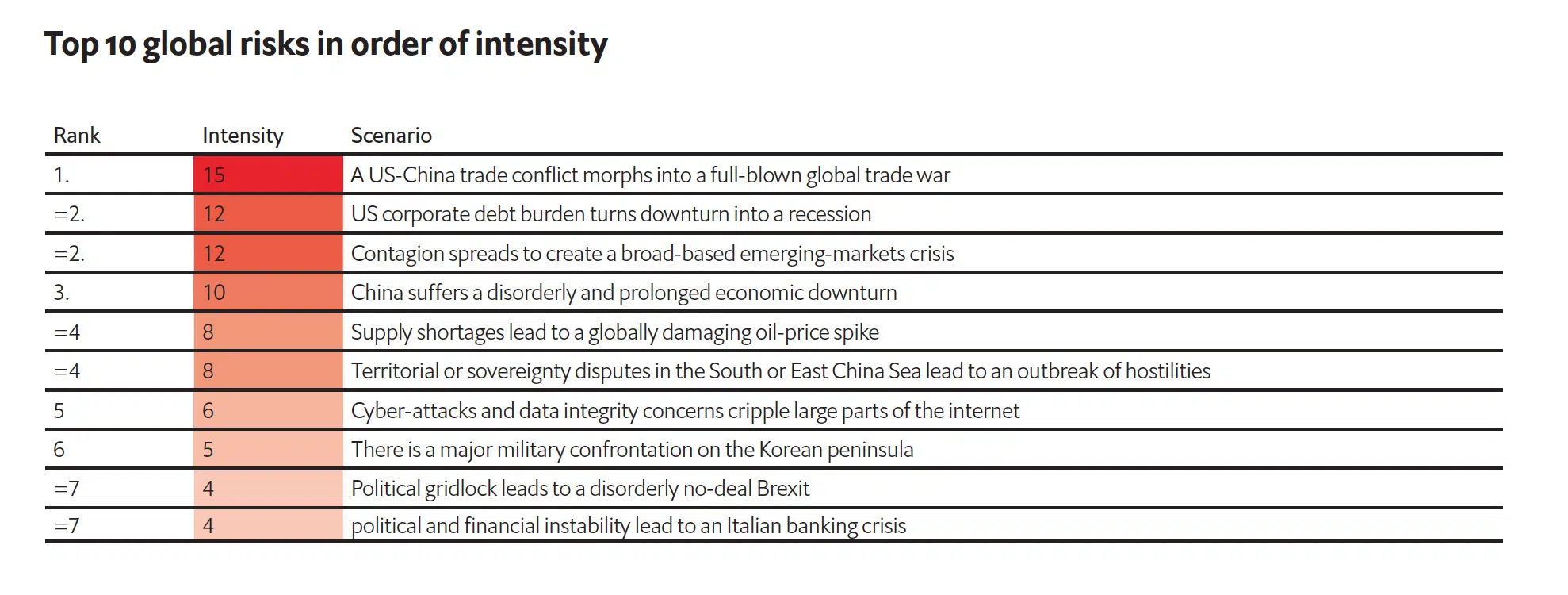
Number 1 concern is the U.S.-China trade conflict, which has the potential to morph into a full-blown global trade war.
China and the United States have started negotiations to resolve the current trade dispute, and the U.S. government has decided to suspend further increases in tariffs on $200 billion-worth of Chinese goods. Talks are likely to yield a limited trade deal — involving Chinese purchases of U.S. agricultural and energy products, but with only broad commitments to domestic economic reform, particularly over structural issues, including technology transfer and intellectual property. While this will avoid an escalation in tensions for now, a full-blown trade war between the United States and China remains a significant risk to the global economy, owing mainly to the fact such a deal will lack the necessary enforcement measures to ensure Chinese commitment to the structural reforms demanded by U.S. negotiators. Moreover, beyond bilateral protectionism, there remains a risk that trade conflicts will escalate on additional fronts in the coming years, to the extent that global trade could actually decline, with major knock-on effects for inflation, business sentiment, consumer sentiment and, ultimately, global economic growth. Currently, the most immediate risk emanates from threats by the U.S. president, Donald Trump, to impose additional tariffs on imports of E.U. cars, which would result in a broader trade conflict as the E.U. attempts to defend its interests. However, there are further related risks. Given rising negative sentiment over national security concerns from countries such as Germany, the United Kingdom, Canada and Australia towards Chinese network providers such as Huawei, there is a risk that a number of additional countries could be dragged into a technology trade war, with international companies’ supply chains disrupted by split global network coverage. As global growth slows, this scenario could also be triggered if a number of countries were to decide to impose broad-based import tariffs and subsidize local industries in order to combat international protectionism. In either of these cases, we would expect global trade to shrink, inflation to rise, consumers’ purchasing power to fall, investment to stagnate and global economic growth to slow.
To read the full report, click here.







